
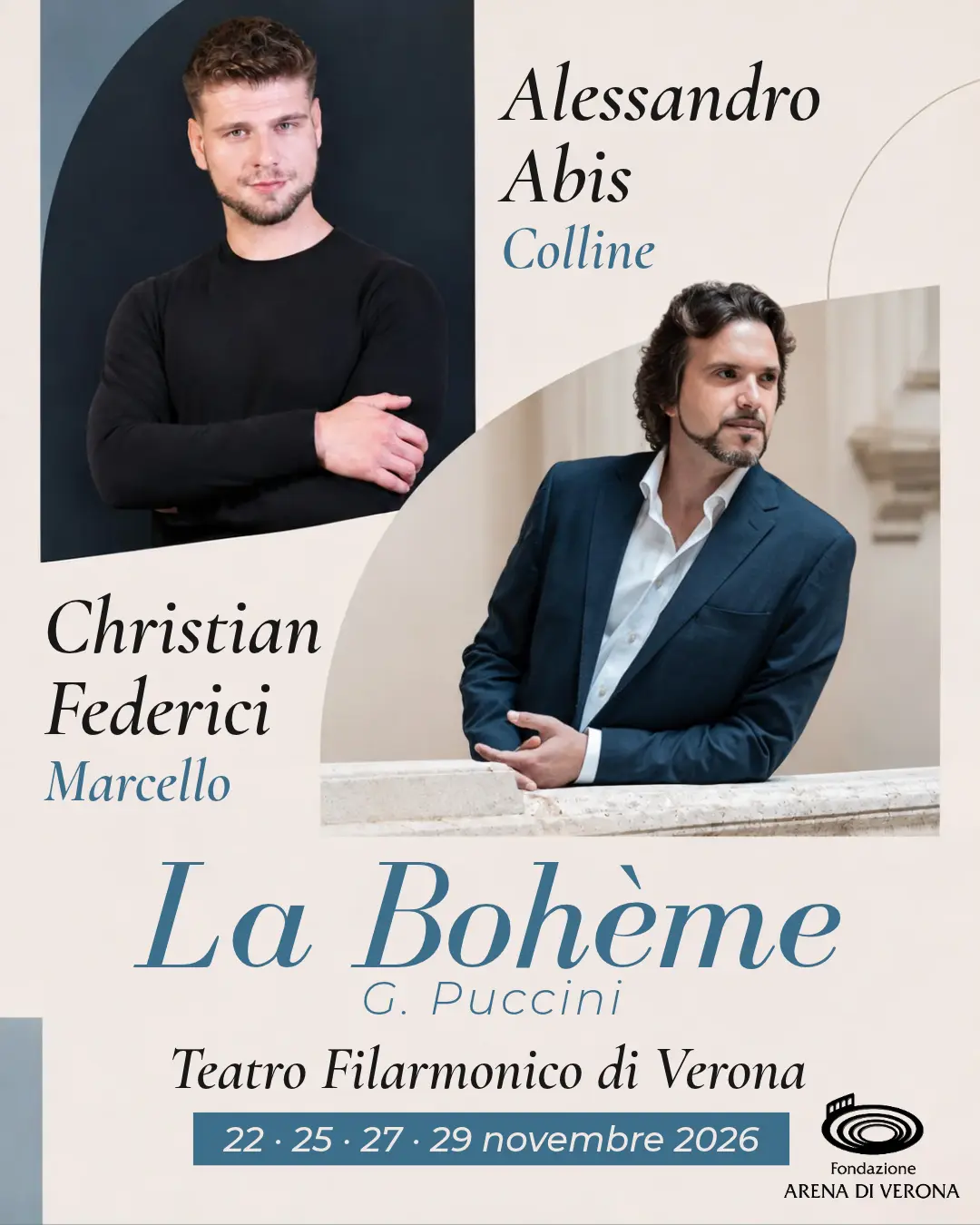
Baritone Christian Federici performs the role of Marcello alongside bass Alessandro Abis as Colline in Giacomo Puccini’s La bohème at the Teatro Filarmonico di Verona, Italy, on November 22, 25, 27 and 29, 2026.
The engagement brings two artists represented by Trucco Management together in one of the most celebrated works of the Italian operatic repertoire. As members of the group of young bohemians at the heart of Puccini’s masterpiece, Marcello and Colline contribute to a story of friendship, artistic ambition, love and loss.
In Verona, Federici and Abis appear in the Fondazione Arena production conducted by Gianna Fratta and directed by Stefano Trespidi, with the Orchestra and Chorus of Fondazione Arena di Verona.
The staging relocates the opera’s visual setting to the Paris of 1968, drawing parallels between the youthful idealism of Puccini’s characters and the cultural and social transformations of the late 1960s.
Performance Details
| Field | Details |
|---|---|
| Opera | La bohème |
| Composer | Giacomo Puccini |
| Librettists | Giuseppe Giacosa and Luigi Illica |
| Featured artists | Christian Federici and Alessandro Abis |
| Voice types | Baritone (Federici); Bass (Abis) |
| Roles | Marcello (Federici); Colline (Abis) |
| Company | Fondazione Arena di Verona |
| Venue | Teatro Filarmonico |
| City / Country | Verona, Italy |
| Performance dates | November 22, 25, 27 and 29, 2026 |
| Conductor | Gianna Fratta |
| Director | Stefano Trespidi |
| Set Designer | Juan Guillermo Nova |
| Costume Designer | Silvia Bonetti |
| Lighting Designer | Paolo Mazzon |
| Chorus Master | Roberto Gabbiani |
| Orchestra | Orchestra di Fondazione Arena di Verona |
| Chorus | Coro di Fondazione Arena di Verona |
| Production | Fondazione Arena di Verona |
| Duration | Approximately 180 minutes, including two intermissions |
Christian Federici as Marcello and Alessandro Abis as Colline
Marcello and Colline are two essential figures in the world of Puccini’s La bohème. Alongside Rodolfo and Schaunard, they form a close-knit group of young artists whose friendship provides both warmth and emotional contrast to the opera’s unfolding tragedy.
Marcello, a painter, combines artistic idealism with a passionate and often turbulent relationship with Musetta. The role demands a baritone capable of balancing lyrical expression, theatrical spontaneity and emotional depth, particularly in the exchanges that reveal the tensions between love, jealousy and friendship.
For Christian Federici, the Verona engagement marks a return to a role already established in his repertoire. He has previously performed Marcello in productions in Ravenna, Rimini, Ferrara and Pisa, developing a close connection with one of Puccini’s most recognisable baritone characters.
Federici’s broader repertoire includes Mozart’s Don Giovanni, the Count of Almaviva in Le nozze di Figaro, Enrico in Donizetti’s Lucia di Lammermoor, Germont in Verdi’s La traviata and Sharpless in Puccini’s Madama Butterfly.
His international career has brought him to important institutions including Teatro alla Scala in Milan, Teatro Real Madrid, Opéra de Marseille, Glyndebourne Festival Opera and Shanghai Opera House.
Colline, by contrast, embodies the philosophical and reflective dimension of the bohemian circle. His character brings moments of humour and intellectual detachment, before revealing profound compassion in the final act.
The role culminates in the celebrated aria Vecchia zimarra, senti, in which Colline bids farewell to his old coat before selling it to help the dying Mimì. This intimate musical moment requires a bass capable of combining warmth of tone, expressive restraint and emotional sincerity.
For Alessandro Abis, the engagement represents another important appearance at the Teatro Filarmonico, where he has previously performed roles including Masetto in Mozart’s Don Giovanni, Conte Robinson in Cimarosa’s Il matrimonio segreto and Don Profondo in Rossini’s Il viaggio a Reims.
Abis has developed an international career encompassing a wide range of bass roles, with a particular connection to the Rossini repertoire. His performances include Mustafà in L’italiana in Algeri, Selim in Il turco in Italia, Don Basilio in Il barbiere di Siviglia and Faraone in Mosè in Egitto.
His repertoire also extends to major operatic works beyond Rossini, including Timur in Puccini’s Turandot, Ferrando in Verdi’s Il trovatore, Leporello in Mozart’s Don Giovanni and Angelotti in Puccini’s Tosca.
The collaboration between Federici and Abis in Verona is particularly significant as the two artists also appeared together at the Teatro Filarmonico earlier in 2026, performing Don Giovanni and Masetto respectively in Mozart’s Don Giovanni.
Their return to the same stage in La bohème offers another opportunity to explore contrasting characters within a shared dramatic world, highlighting the interplay between friendship, individual expression and collective emotion.
Stefano Trespidi’s production places the opera against the backdrop of the cultural revolution of 1968, presenting Puccini’s timeless story through images associated with youth, freedom and social change.
Under the musical direction of Gianna Fratta, Christian Federici and Alessandro Abis join an international cast including Hasmik Torosyan as Mimì, Galeano Salas as Rodolfo and Enkeleda Kamani as Musetta, bringing Puccini’s celebrated masterpiece to the Teatro Filarmonico stage.
For biographies, repertoire, media, press materials and booking enquiries, visit the Trucco Management artist profiles of Christian Federici and Alessandro Abis, or contact Trucco Management directly.