
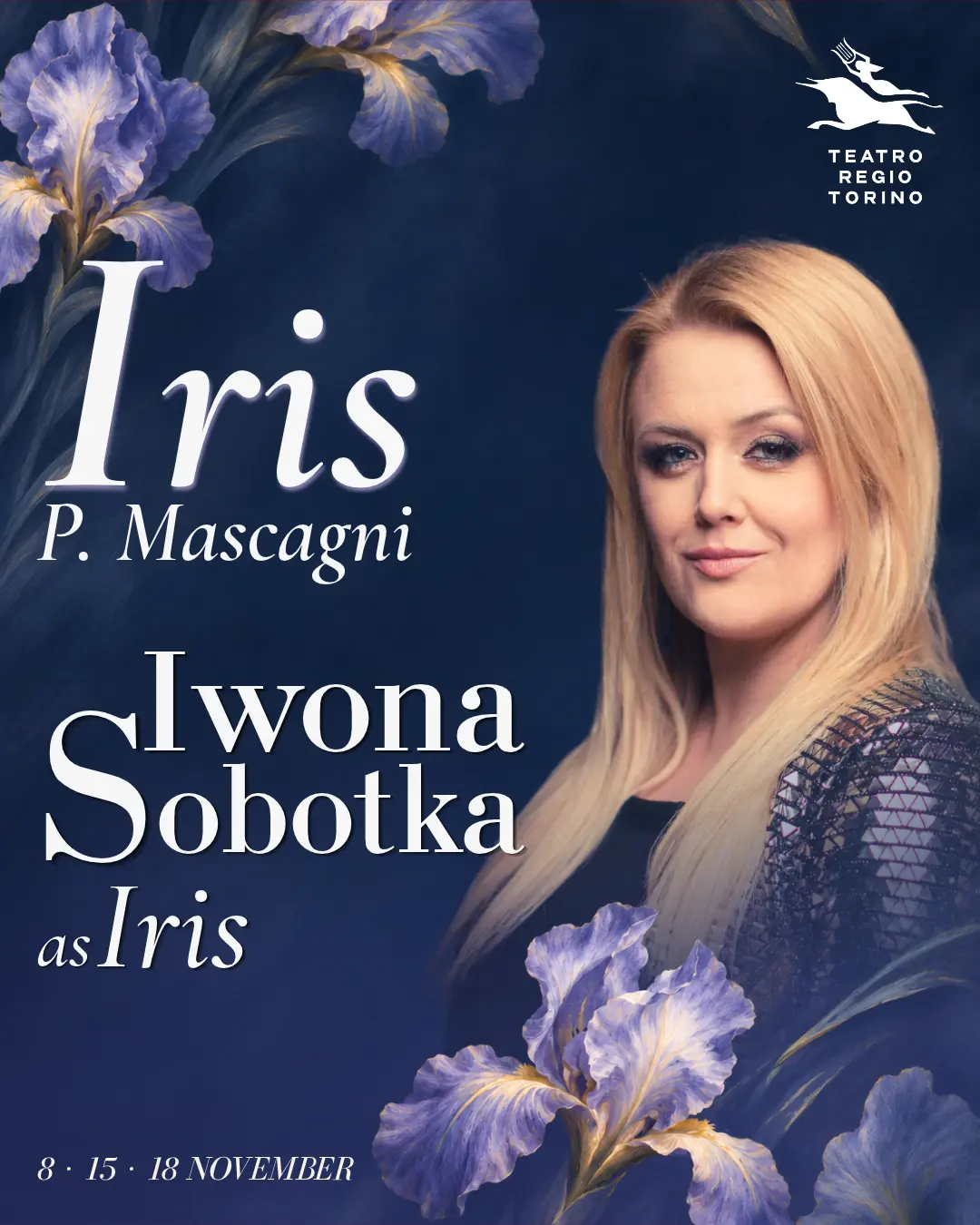
Soprano Iwona Sobotka performs the title role in Pietro Mascagni’s Iris at the Teatro Regio di Torino, Italy, on November 8, 15 and 18, 2026.
The engagement brings Sobotka to one of the most fascinating and psychologically complex soprano roles in the Italian verismo repertoire. First performed in 1898, Iris combines Mascagni’s expressive musical language with a symbolist drama exploring innocence, suffering and the conflict between human cruelty and spiritual purity.
In Turin, Sobotka appears in a new production conducted by Andrea Battistoni and directed by Daniele Menghini, with the Orchestra and Chorus of Teatro Regio Torino.
Performance Details
| Field | Details |
|---|---|
| Opera | Iris |
| Composer | Pietro Mascagni |
| Librettist | Luigi Illica |
| Featured artist | Iwona Sobotka |
| Voice type | Soprano |
| Role | Iris |
| Company | Teatro Regio Torino |
| Venue | Teatro Regio |
| City / Country | Turin, Italy |
| Iwona Sobotka performance dates | November 8, 15 and 18, 2026 |
| Performance times | 3:00 PM |
| Conductor | Andrea Battistoni |
| Director | Daniele Menghini |
| Set Designer | Davide Signorini |
| Costume Designer | Nika Campisi |
| Choreographer | Marco Caudera |
| Puppet Choreography | Valeria Sacco (Riserva Canini Teatro) |
| Lighting Designer | Gianni Bertoli |
| Dramaturgy | Michele Panella |
| Chorus Master | Gea Garatti Ansini |
| Orchestra | Orchestra Teatro Regio Torino |
| Chorus | Coro Teatro Regio Torino |
| Production | New production by Teatro Regio Torino |
| Duration | Approximately 185 minutes, including two intermissions |
Iwona Sobotka as Iris
Iris is one of the most distinctive and emotionally demanding heroines in Pietro Mascagni’s operatic repertoire. Unlike the passionate realism of Cavalleria rusticana, the opera explores a more introspective and symbolist world, where innocence, fear and suffering unfold against an imagined Japanese setting.
The title role requires a soprano capable of combining lyrical sensitivity with dramatic intensity. Iris’s journey from youthful innocence to devastating disillusionment demands exceptional expressive control, sustained vocal presence and the ability to communicate profound psychological transformation.
For Iwona Sobotka, the engagement represents a significant addition to an international career increasingly centred on the great dramatic and spinto soprano roles. Her repertoire includes major Verdian heroines such as Aida, Leonora in Il trovatore, Amelia in Simon Boccanegra, Desdemona in Otello and Elisabeth in Don Carlo, alongside Puccini roles including Tosca, Manon Lescaut, Cio-Cio-San in Madama Butterfly and Turandot.
These portrayals reflect a vocal and theatrical profile combining expressive lyricism, dramatic authority and the ability to sustain complex emotional narratives.
Sobotka’s international career has taken her to major opera houses and concert halls, including the Opéra national de Paris, Teatro Real Madrid, Komische Oper Berlin, Polish National Opera and Salzburg Festival. She has collaborated with distinguished conductors such as Riccardo Muti, Sir Simon Rattle, Semyon Bychkov and Marek Janowski.
Her artistic achievements also extend to the concert repertoire. Winner of the Grand Prix and First Prize at the Queen Elisabeth International Vocal Competition in Brussels in 2004, Sobotka has established a particularly strong reputation for her interpretations of Polish vocal music, especially the works of Karol Szymanowski.
At Teatro Regio Torino, her interpretation of Iris forms part of a new staging by Daniele Menghini, which reimagines Mascagni’s symbolist drama in a post-atomic world. The production draws inspiration from the concept of hibakujumoku, the trees that survived the atomic bombings of Hiroshima and Nagasaki, transforming the opera’s imagery of nature and renewal into a reflection on destruction, survival and hope.
Under the musical direction of Andrea Battistoni, Sobotka brings her experience in Italian dramatic repertoire to a work that occupies a distinctive place in Mascagni’s legacy, offering an opportunity to explore the expressive depth and psychological vulnerability of its central character.
For biography, repertoire, media, press materials and booking enquiries, visit Iwona Sobotka’s Trucco Management artist profile or contact Trucco Management directly.